
MAGEMin_C Li partitioning, fractional melting
Table of contents
The objective of this tutorial is to build upon the batch melting lithium partitioning example and update it to model fractional melting.
1. Create a new script
code MAGEMin_C_Li_partitioning_fractional_melting.jl2. Use partitioning_batch_melting.jl as starting point
- Copy and paste the partition batch melting model definition part:
using MAGEMin_C, Plots, ProgressMeter
include("functions.jl")

dtb         = "mp"
KD_set      = "KO" #or "BA"
data        =  Initialize_MAGEMin(dtb, verbose=false);

X           = [0.5922, 0.1813, 0.006, 0.0223, 0.0633, 0.0365, 0.0127, 0.0084, 0.0016, 0.0007, 0.075]
Xoxides     = ["SiO2", "Al2O3", "CaO", "MgO", "FeO", "K2O", "Na2O", "TiO2", "O", "MnO", "H2O"]
sys_unit    = "wt"

P           = 5.0
T_step      = 2.0
T           = [600:T_step:1000;]
n_calc      = length(T)

Out_XY      = Vector{out_struct}(undef,n_calc)
Out_TE_XY   = Vector{out_TE_struct}(undef,n_calc)


el          = ["Li"]
ph          = ["afs", "amp", "bi", "cpx", "cd", "g", "hem", "ilm", "ky", "mt", "mu", "opx", "pl", "q", "ru", "sill"]

if KD_set == "KO"
    KDs     = ["0.01";  "1e-4";  "1.67"; "1e-4";  "0.44"; "1e-4"; "1e-4"; "1e-4";  "1e-4"; "1e-4"; "0.82"; "1e-4";  "0.02"; "1e-4"; "1e-4"; "1e-4"]
elseif KD_set == "BA"
    KDs     = ["1e-4"; "1e-4"; "0.55"; "1e-4"; "1.10"; "0.09"; "1e-4"; "1e-4"; "1e-4"; "1e-4"; "0.11"; "1e-4"; "1e-4"; "1e-4"; "1e-4"; "1e-4"]
end

C_te        = [400.0]       #starting mass fraction of elements in ppm (ug/g)
KDs_dtb     = create_custom_KDs_database(el, ph, KDs)
3. Fractional melting
- Add the fractional melting block from
MAGEMin_C_Li_partitioning_batch_melting.msection 5 (Tracking the evolution of the system mass):
MCT             = 0.07

M_system        = 1.0                      # track mass relative to original
extracted_M_wt  = zeros(Float64, n_calc)
M_system_evol   = zeros(Float64, n_calc)

residual_comp_wt = copy(X)
 #= TO BE COMPLETED =#
@showprogress for i in 1:n_calc
    Out_XY[i]       = single_point_minimization(P, T[i], data, X=residual_comp_wt, Xoxides=Xoxides, sys_in=sys_unit, name_solvus = true, scp=1)
    #= TO BE COMPLETED =#

    # mass per unit volume of each sub-system
    m_M     = Out_XY[i].rho_M * Out_XY[i].frac_M_vol
    m_S     = Out_XY[i].rho_S * Out_XY[i].frac_S_vol
    m_total = m_M + m_S

    if Out_XY[i].frac_M_vol > MCT
        m_M_retained     = Out_XY[i].rho_M * MCT
        m_extracted      = Out_XY[i].rho_M * (Out_XY[i].frac_M_vol - MCT)

        # extracted melt as fraction of original system mass
        extracted_M_wt[i] = (m_extracted / m_total) * M_system

        # update remaining system mass
        M_system -= extracted_M_wt[i]

        # residual = retained melt + solid
        residual_comp_wt = m_M_retained .* Out_XY[i].bulk_M_wt .+ m_S .* Out_XY[i].bulk_S_wt
        #= TO BE COMPLETED =#

    else
        residual_comp_wt = m_M .* Out_XY[i].bulk_M_wt .+ m_S .* Out_XY[i].bulk_S_wt
        #= TO BE COMPLETED =#
    end

    M_system_evol[i] = M_system
    Xoxides          = Out_XY[i].oxides
end- While the previous block handles fractional melting when melt fraction reaches the melt connectivity threshold (MCT), Li partitioning is not yet accounted for.
Exercises
E.1. Lithium partitioning
Add Li partitioning to the fractional melting calculation:
Define
residual_TE_comp = copy(C_te)before the iteration loopAfter
single_point_minimization()addOut_TE_XY[i] = TE_prediction(Out_XY[i], residual_TE_comp, KDs_dtb, dtb)Add to the
if, elsestatement the update of theresidual_TE_compin a similar way as for the bulk-rock composition (do not normalize here!)
Perform calculation using MCT = 0.07, KO Li partition coefficient set and display melt Li enrichment. This gives:
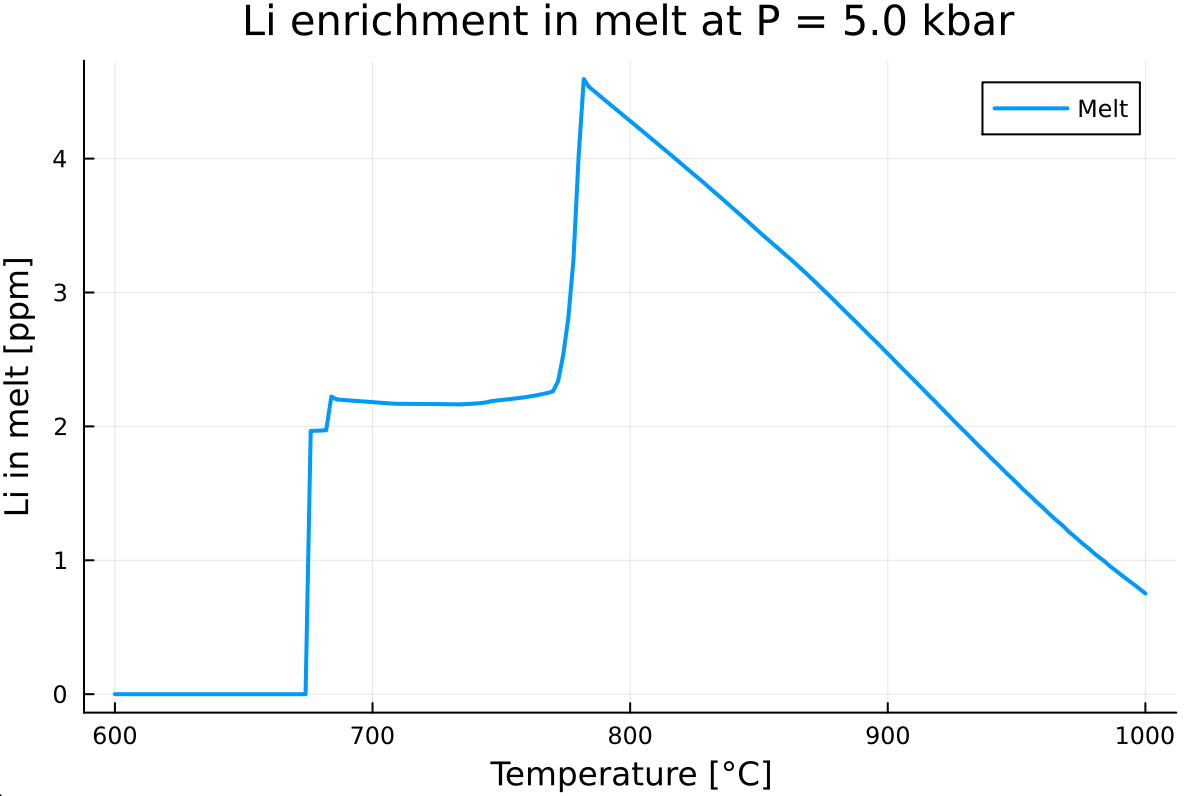
- How does that compare with the batch melting experiment?
E.2. Visualization
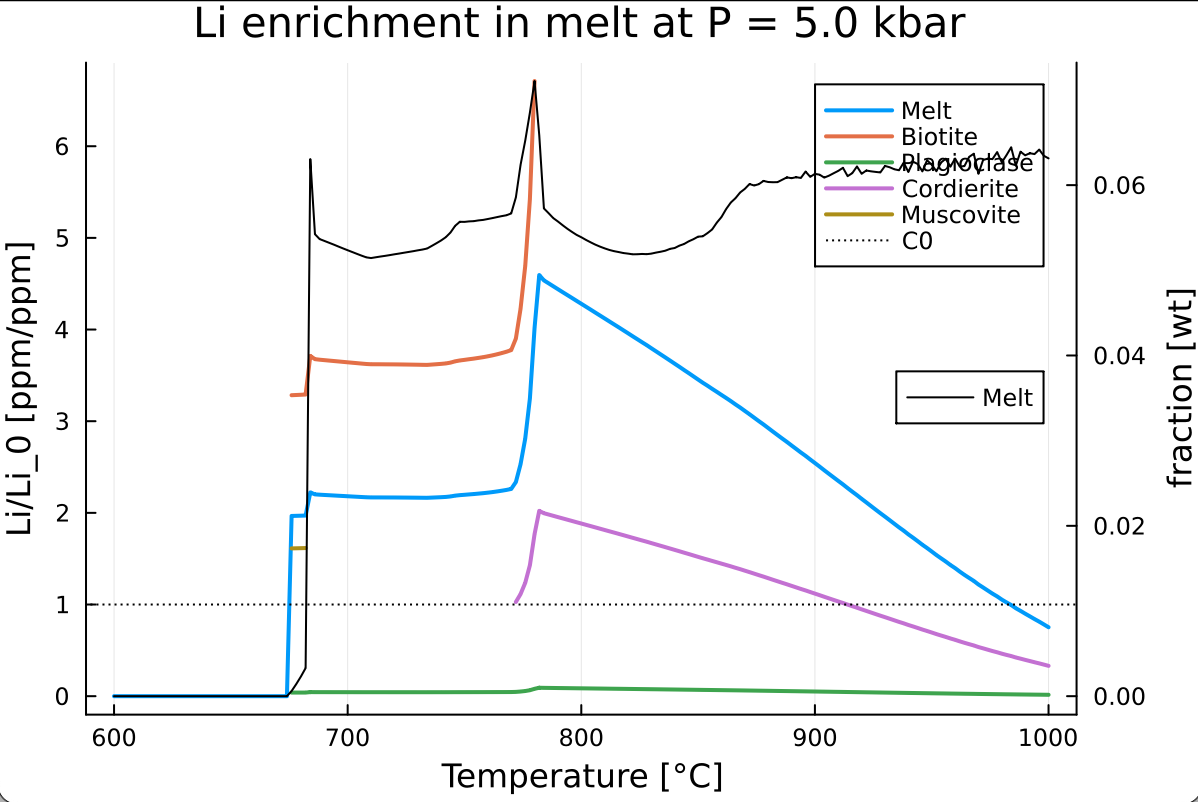
- Using the function from batch melting partitioning example, plot the evolution of the lithium enrichment of melt, biotite, plagioclase, cordierite, and muscovite. This should give something similar to:
E.3. Role of partition coefficient set and pressure
- Perform the calculation using both BA and KO sets of partition coefficients at different pressures. How different are the results compared to the batch melting experiments?
4. Non-linear partition coefficient model
While using constant partition coefficients is helpful to investigate the first order evolution of the Li mass fraction during partial melting, this is certainly a strong simplification as partition coefficient are known to be pressure, temperature as well as composition dependent.
For Lithium partitioning a recently published study (Beard et al., 2026; in press) has provided a new temperature and composition-dependent model for Li partitioning between biotite and melt:

where
- MAGEMin_C allows the user to provide expressions for non-linear partition coefficient models. For instance starting from the definition of the partition coefficients as in tutorial
MAGEMin_C_Li_partitionig.jl:
el      = ["Li"]
ph      = ["afs", "amp", "bi", "cpx", "cd", "g", "hem", "ilm", "ky", "mt", "mu", "opx", "pl", "q", "ru", "sill"]
KDs     = ["0.01";  "1e-4";  "1.67"; "1e-4";  "0.44"; "1e-4"; "1e-4"; "1e-4";  "1e-4"; "1e-4"; "0.82"; "1e-4";  "0.02"; "1e-4"; "1e-4"; "1e-4"]
When wanting to update the partition coefficient expression for bi one would need to replace the ".67 entry in the KDs Vector{String} to:
KDs = ["0.01"; "1e-4"; bi_exp; "1e-4"; "0.44"; "1e-4"; "1e-4"; "1e-4"; "1e-4"; "1e-4"; "0.82"; "1e-4"; "0.02"; "1e-4"; "1e-4"; "1e-4"]where:
bi_exp = "y = [:bi].compVariables[3];f = [:bi].compVariables[4]; bi_xSiT = 0.5-f/2.0 - y/2.0;bi_SiT = (2.0 * bi_xSiT)+2.0; ln_D_Li = (-22.359) + (5.592*bi_SiT) + (10000*0.67*1/(T_C+273.15)); exp(ln_D_Li)"Notice that the site fraction
is computed using the composition variables yandffrom biotite (see THERMOCALC formulation for more details)Moreover, the formula will be evaluated and turned into a function at compilation time, hence will not decrease the performances of the calculation.
Exercises
E.1. Non-linear biotite partition coefficient model
Using previous expression for the partition coefficient model between biotite and melt for Lithium, update your fractional melting code to use it.
Perform the calculations using the non-linear
for both Koopmans (2024) and Ballouard (2023) sets of partition coefficients How much control does the non-linear
model have on the maximum Li enrichment?