
MAGEMin_C Li partitioning
Table of contents
The objective of this tutorial is to demonstrate how to add trace-element partitioning to stable phase equilibrium predictions. As an example, we will model Li partitioning during partial melting of a metapelite using the metapelite
mpdatabase (White et al., 2014).The partition coefficients used to predict partitioning between minerals and melt are taken from two studies: Ballouard et al. (2023) and Koopmans et al. (2024).
| Mineral | Acronym | K_D BA | K_D KO |
|---|---|---|---|
| Alkali-feldspar | afs | 1e-4 | 0.01 |
| Amphibole | amp | 1e-4 | 1e-4 |
| Biotite | bi | 0.55 | 1.67 |
| Clinopyroxene | cpx | 1e-4 | 1e-4 |
| Cordierite | cd | 1.10 | 0.44 |
| Garnet | g | 0.09 | 1e-4 |
| Hematite | hem | 1e-4 | 1e-4 |
| Ilmenite | ilm | 1e-4 | 1e-4 |
| Kyanite | ky | 1e-4 | 1e-4 |
| Magnetite | mt | 1e-4 | 1e-4 |
| Muscovite | mu | 0.11 | 0.82 |
| Orthopyroxene | opx | 1e-4 | 1e-4 |
| Plagioclase | pl | 1e-4 | 0.02 |
| Quartz | q | 1e-4 | 1e-4 |
| Rutile | ru | 1e-4 | 1e-4 |
| Sillimanite | sill | 1e-4 | 1e-4 |
BA = Ballouard et al., 2023; KO = Koopmans et al., 2024
Batch melting equations
To predict the mass content of Li in both the solid and liquid phases, MAGEMin uses trace-element batch melting equations (Shaw, 1970; Hertogen & Gijbels, 1976; Zou, 2001):
and
where
where
1. Create a new script
code MAGEMin_C_Li_partitioning.jl2. Initialize
Let's first initialize MAGEMin using the world median pelite composition:
using MAGEMin_C, Plots, ProgressMeter
dtb         = "mp"
data        =  Initialize_MAGEMin(dtb, verbose=false);

X           = [0.5922, 0.1813, 0.006, 0.0223, 0.0633, 0.0365, 0.0127, 0.0084, 0.0016, 0.0007, 0.075]
Xoxides     = ["SiO2", "Al2O3", "CaO", "MgO", "FeO", "K2O", "Na2O", "TiO2", "O", "MnO", "H2O"]
sys_unit    = "wt"

P           = 5.0
T           = 700.0
3. Define partition coefficients
Let's now define the lithium partition coefficients between minerals and melt using Koopmans et al. (2024) values:
el          = ["Li"]
ph          = ["afs", "amp", "bi", "cpx", "cd", "g", "hem", "ilm", "ky", "mt", "mu", "opx", "pl", "q", "ru", "sill"]
KDs = ["0.01"; "1e-4"; "1.67"; "1e-4"; "0.44"; "1e-4"; "1e-4"; "1e-4"; "1e-4"; "1e-4"; "0.82"; "1e-4"; "0.02"; "1e-4"; "1e-4"; "1e-4"]- Here,
KDsis a Matrix of String of size (n_ph,n_el):
| KDs | el_1 | el_2 | ... | el_m |
|---|---|---|---|---|
| ph_1 | KD_1,1 | KD_1,2 | ... | KD_1,m |
| ph_2 | KD_2,1 | KD_2,2 | ... | KD_2,m |
| ... | ... | ... | ... | ... |
| ph_n | KD_n,1 | KD_n,2 | ... | KD_n,m |
where n is the total number of phases and m is the total number of trace elements.
4. Define starting mass fraction and partition coefficient database
Then, we need to define the starting mass fraction and create the custom partition coefficients database:
C_te        = [400.0]       #starting mass fraction of elements in ppm (ug/g)
KDs_dtb     = create_custom_KDs_database(el, ph, KDs)
5. Perform stable phase equilibrium calculation
Let's now compute the stable equilibrium (without trace-element prediction):
out = single_point_minimization(P, T, data, X=X, Xoxides=Xoxides, sys_in=sys_unit, name_solvus = true)6. Perform trace-element prediction modelling
We can now compute trace-element partitioning by calling the TE_prediction() function, while passing the result of the minimization out, the starting mass fraction C_te, the partition coefficient database KDs_dtb, and the database name dtb as arguments:
out_TE = TE_prediction(out, C_te, KDs_dtb, dtb)7. Access result of trace-element partitioning
Results of trace-element prediction are stored in the out_TE structure:
out_TE.
C0            Cliq          Cmin          Csol
Sat_P2O5_liq  Sat_S_liq     Sat_Zr_liq    bulk_D
bulk_cor_mol  bulk_cor_wt   elements      fapt_wt
liq_wt_norm   ph_TE         ph_wt_norm    sulf_wt
zrc_wt
The melt lithium mass fraction is stored in:
out_TE.Cliq
1-element Vector{Float64}:
 714.3816978649379
The mineral phases hosting Li are listed in:
out_TE.ph_TE
5-element Vector{String}:
 "pl"
 "hem"
 "bi"
 "q"
 "sill"
and the lithium mass fraction of these phases is stored in:
out_TE.Cmin
5×1 Matrix{Float64}:
  14.287633957298759
   0.0714381697864938
1193.0174354344463
   0.0714381697864938
   0.0714381697864938
8. Visualize Li enrichment
The variations in lithium mass fractions are best visualized by normalizing to the starting mass out_TE.C0. To achieve this, let's create a bar graph:
First, combine phase names and melt:
labels = [out_TE.ph_TE; "melt"]Then, combine mineral and melt Li concentrations:
Li_norm = [out_TE.Cmin[:, 1]; out_TE.Cliq[1]] ./ out_TE.C0- Note that
out_TE.Cminis a matrix, whileout_TE.Cliqis a vector of length 1.
bar(labels, Li_norm,
    ylabel    = "Li norm [Li/Li₀]",
    title     = "Li partitioning at P = $(P) kbar, T = $(T) °C",
    legend    = false,
    xrotation = 45,
    color     = reshape(1:length(labels), 1, :))

hline!( [1.0],
        linestyle   = :dot,
        linecolor   = :black,
        label       = "C0")
This gives:
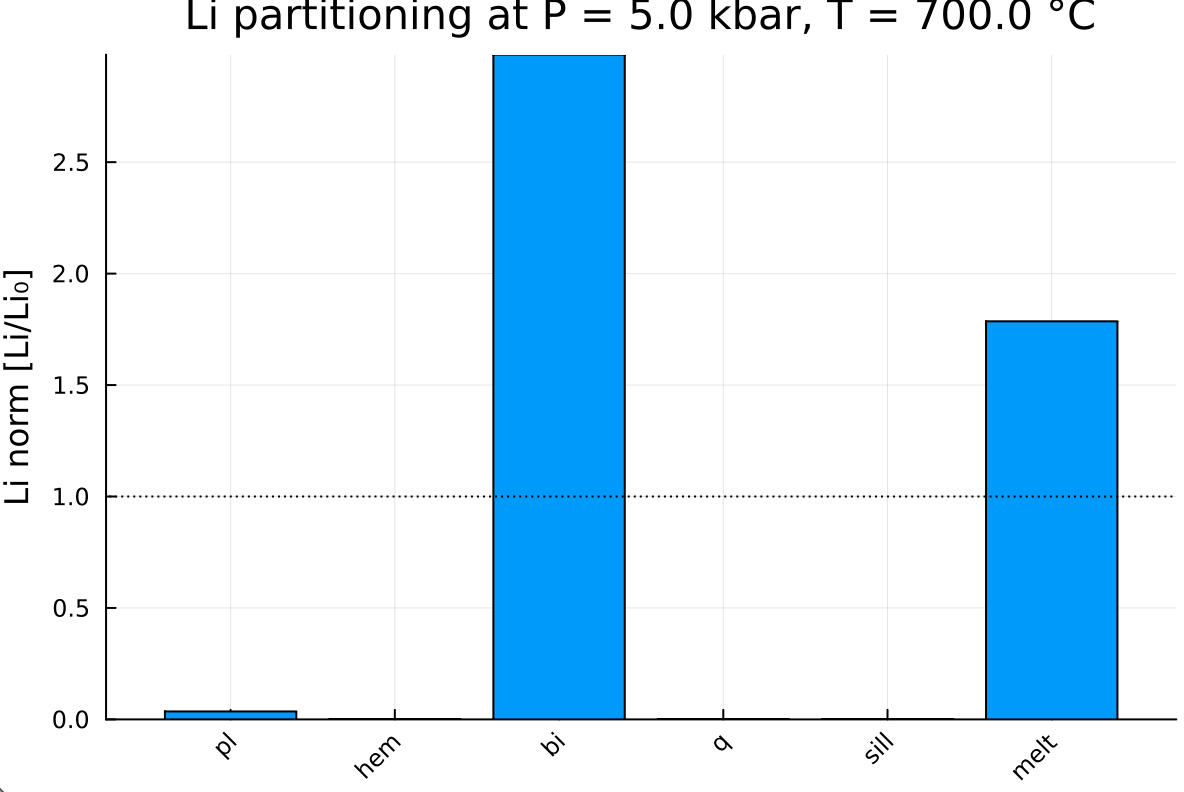
- The horizontal dashed line at 1.0 represents the starting mass fraction.
Exercises
E.1. Batch melting
Using the previous tutorials on batch melting, duplicate this script and modify it to perform Li partitioning prediction between 600 and 1000.0 °C with a step of 2 °C.
- Remember to pre-allocate the
outandout_TEstructures as:julia Out_XY = Vector{out_struct}(undef,n_calc) Out_TE_XY = Vector{out_TE_struct}(undef,n_calc)
- Remember to pre-allocate the
Extract the Li mass fraction in the liquid, normalize it using the initial mass fraction, and visualize the result. This gives:
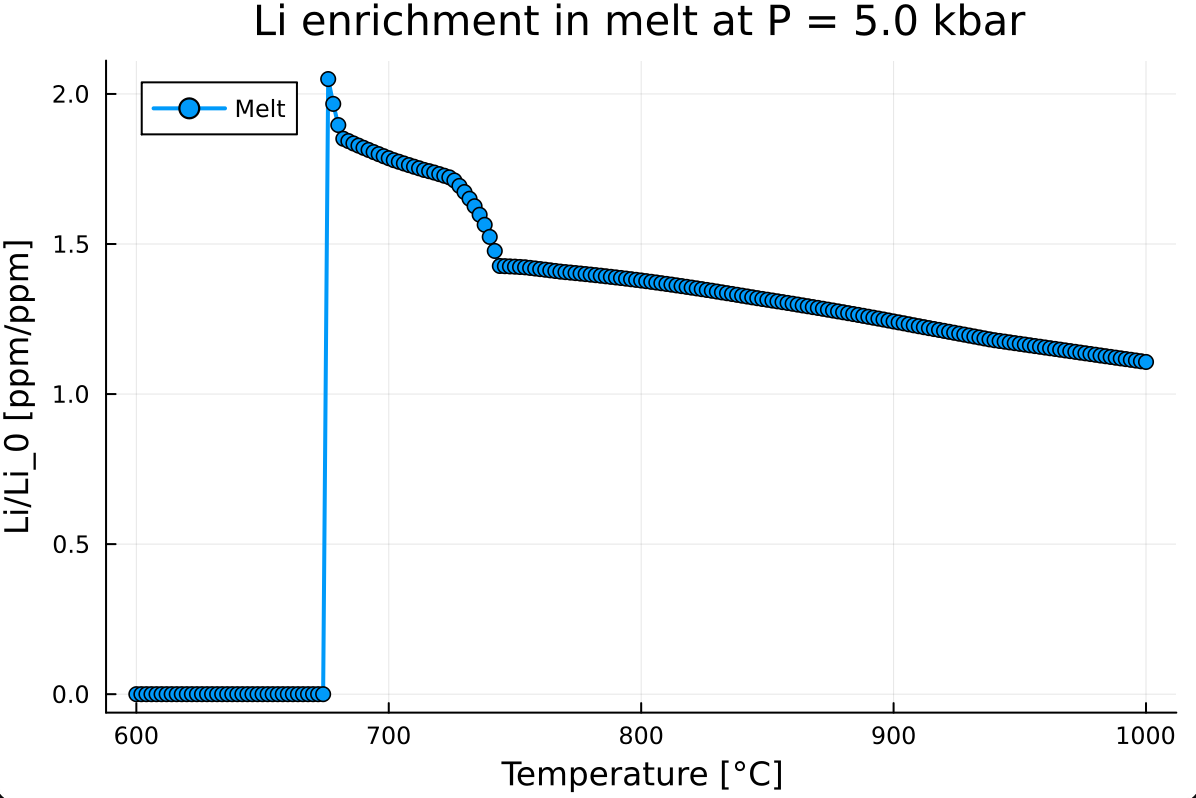
- Perform the same calculation at various pressures (2.0, 4.0, 8.0, and 12.0 kbar). How does pressure control the maximum lithium enrichment of the melt?
E.2. Extract mineral Li enrichment
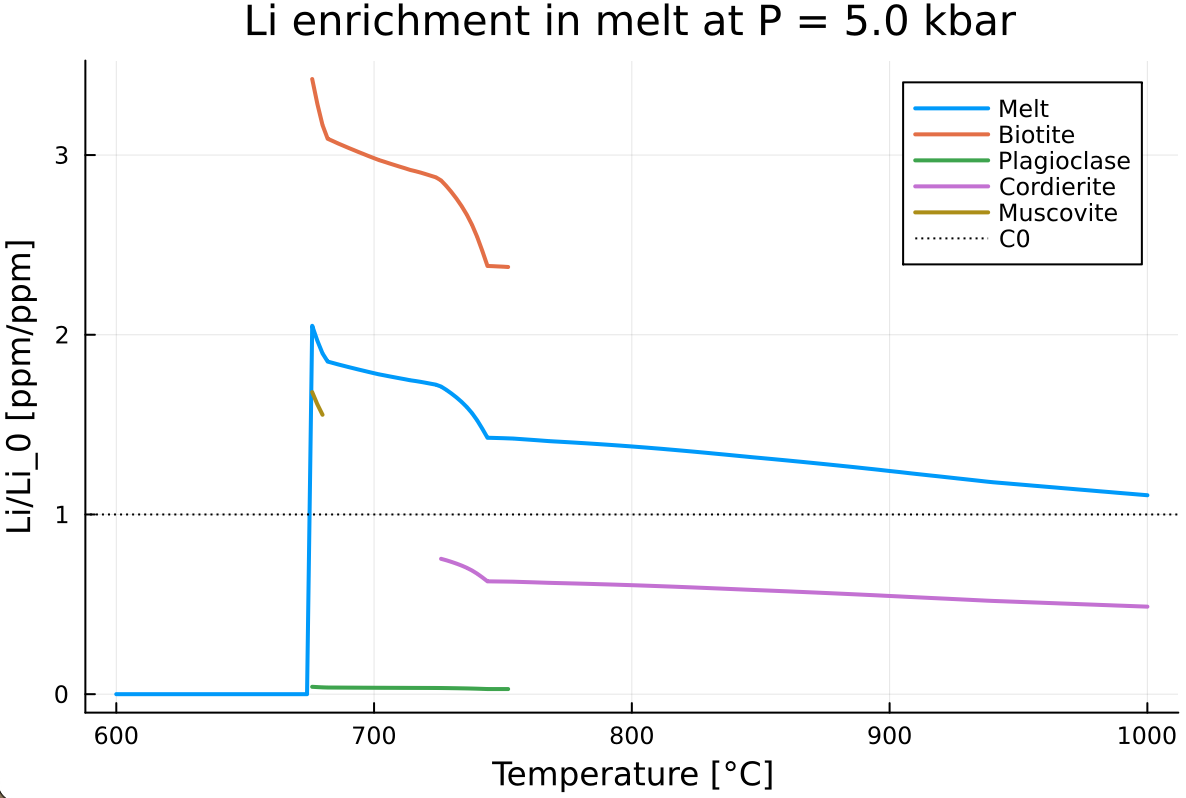
- Create a function that reads the trace-element output structure
Out_TE_XY, the starting Li mass fraction, a Li-bearing mineral name, and returns a vector of Li enrichment:
function get_Li_enrichment(Out_TE_XY, C0, phase)
#... make the function yourself ...
return Li_ratio_phase
end- Plot the evolution of the lithium enrichment of melt, biotite, plagioclase, cordierite, and muscovite. This should give something similar to:
Now add as a twinx(), the evolution of the melt fraction in wt
What is the relationship between Li enrichment in the melt, biotite and melt fraction?
E.3. Different set of partition coefficients
Let's now use a different set of partition coefficients. Modify your script to add an option for choosing between KO (Koopmans et al., 2024) and BA (Ballouard et al., 2023)
Perform the calculation using BA set of partition coefficients
How does this change the maximum Li enrichment in the melt? How do you explain it?
Compare Li enrichment prediction between BA and KO sets at various pressures. How important is the choice of partition coefficients?