
Info
MAGEMinApp.jl Tips
Tip
Mind that when performing a calculation progress is indicated either by the progress bar at the top right corner of the interface, or by changing the name of your web-browser tab (where
MAGEMinAppis opened) toUpdating...Once a calculation is launched, avoid performing other actions as it may lead to calculation failure
MAGEMinApp.jl interface
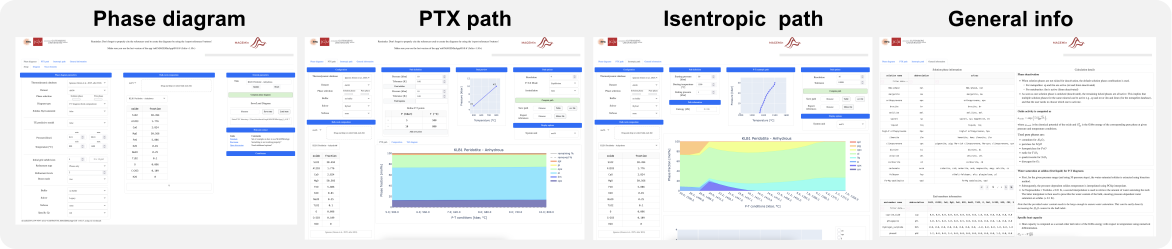
The graphic user interface includes 4 main tabs: one for app-wide settings, two for phase equilibrium calculations, and one for supporting reference data.
App-wide settings that apply across every other tab: mineral naming convention, pressure display unit, output directory, plus contributors, third-party libraries and support/contact information.
Available thermodynamic databases are presented here. All other options and parameters are detailed below.
1. General setup tab
App-wide settings that apply across every other tab.
1.1. General parameters panel
| General parameters | Caption |
|---|---|
|
Warning
IntersecT (§5) matches phases between a measurement file and the computed grid using the Warr (2021) symbols. Set Mineral names = Warr (2021) here before using it, otherwise no phase will be found in common.
1.2. Contributors panel
List of people who contributed to MAGEMinApp, together with app/version information.
1.3. External libraries panel
Third-party tools integrated into MAGEMinApp, currently IntersecT (Nerone et al., 2025, doi:10.1016/j.cageo.2025.105949) - an open-source Python package for statistically quantifying the quality of fit in isopleth thermobarometry.
1.4. Help and contact panel
Links for documentation, reporting issues on GitHub, the GitHub repository, and the Discord server.
2. Phase diagrams tab
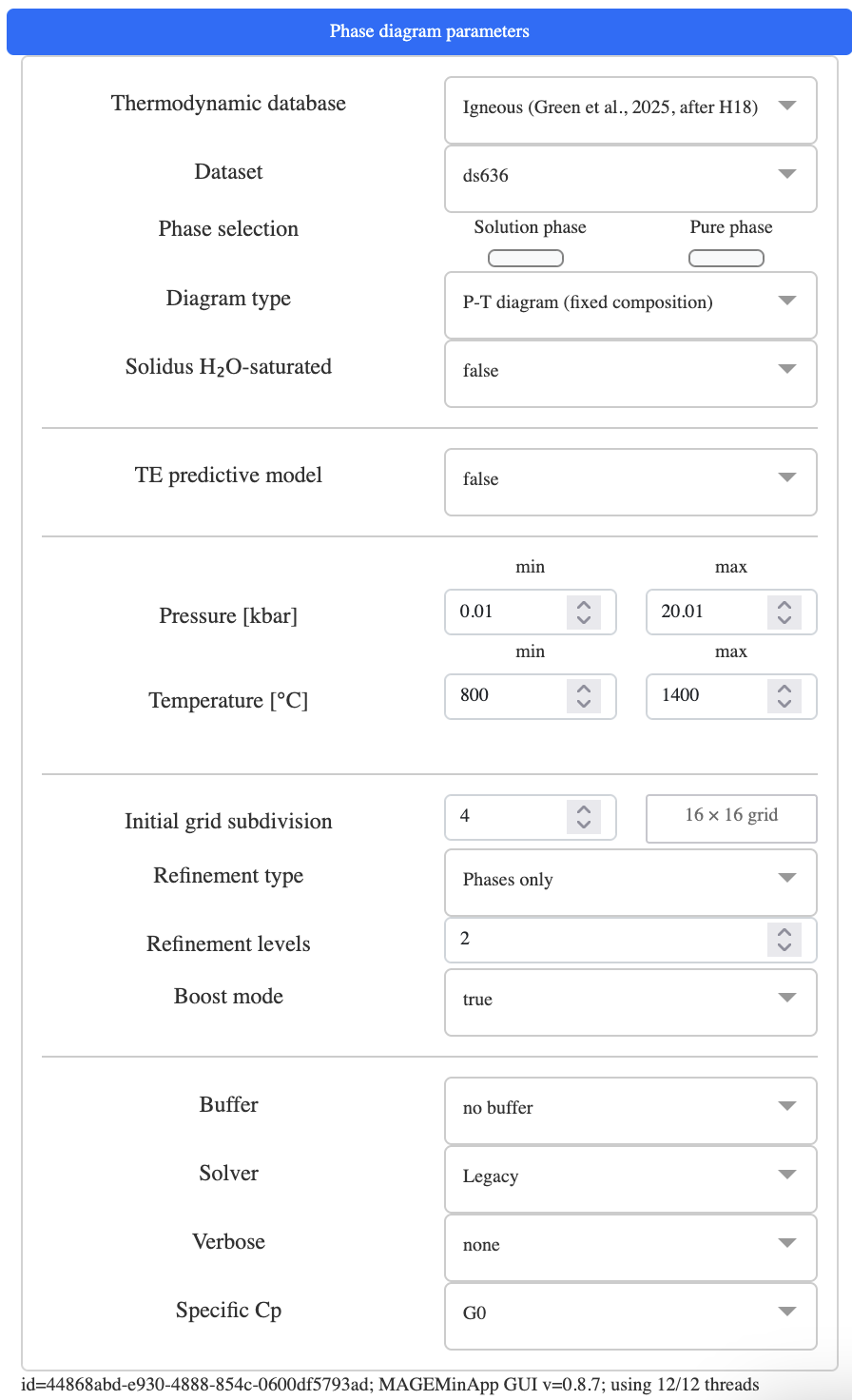
2.1. Setup panel
| Setup | Caption |
|---|---|
 |
|
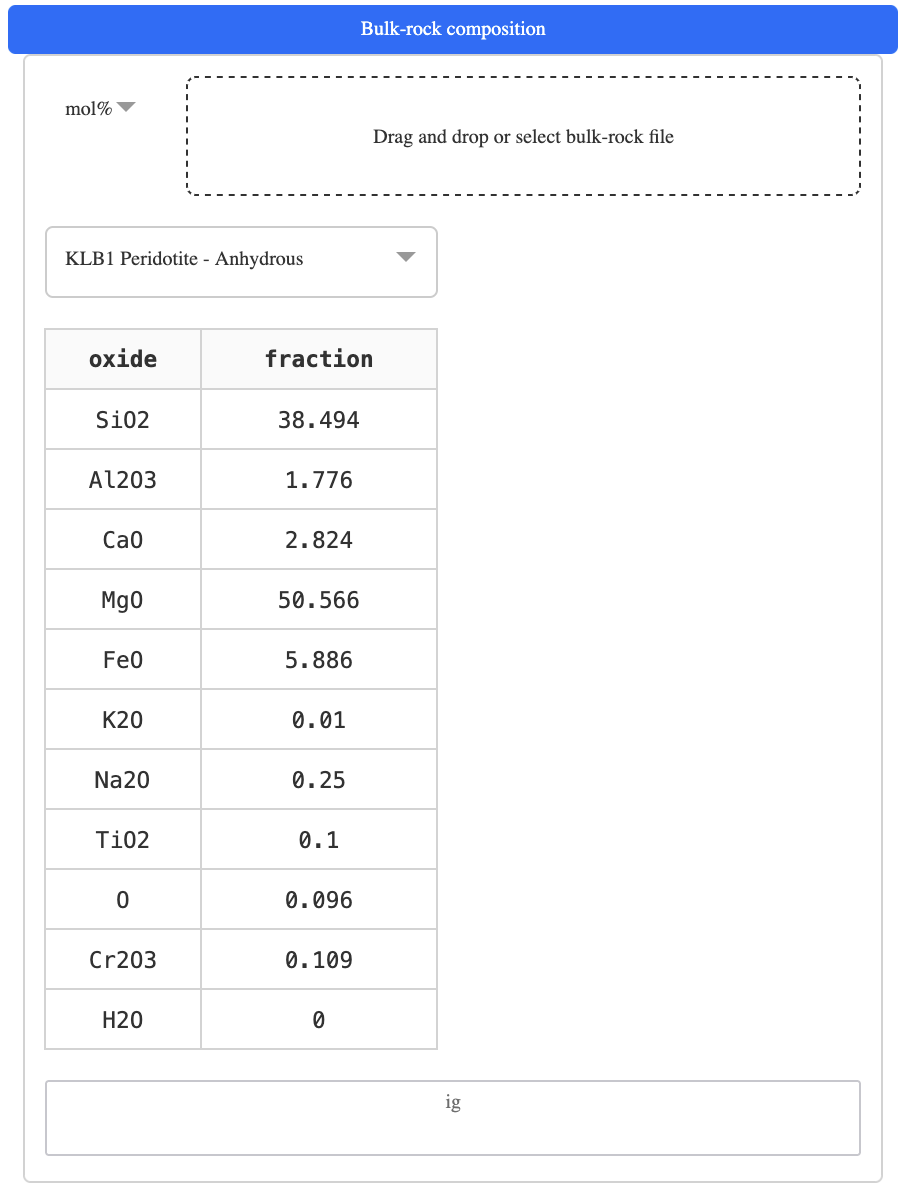
2.2. Bulk-rock composition panel
| Setup | Caption |
|---|---|
 |
|
2.3. Trace-element composition panel
When TE predictive model = true, a third collapsible panel appears below the bulk-rock panel:
| Trace-element panel | Caption |
|---|---|
|
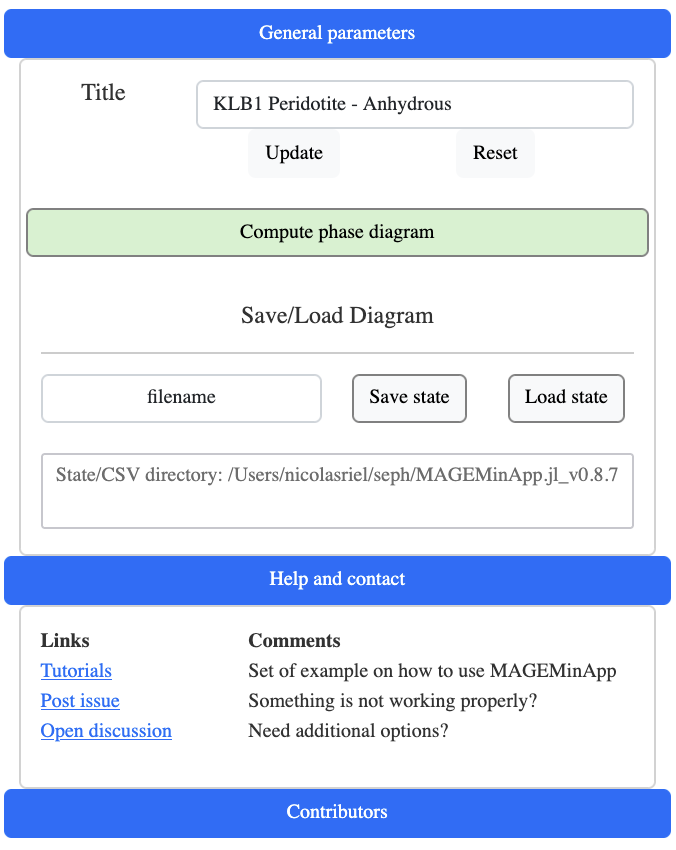
2.4. General parameters panel
| General parameters | Caption |
|---|---|
 |
|
Note
Contributors, external libraries and help/contact information moved to the top-level 1. General setup tab.
3. Diagram sub-tab
The Diagram sub-tab has a right-hand sidebar with six tabs: Informations, Display options, Isopleths, Draw path, Uncertainty, and Classifications.
3.1. Informations panel
| Informations | Caption |
|---|---|
|
3.2. Display options panel
| Display options | Caption |
|---|---|
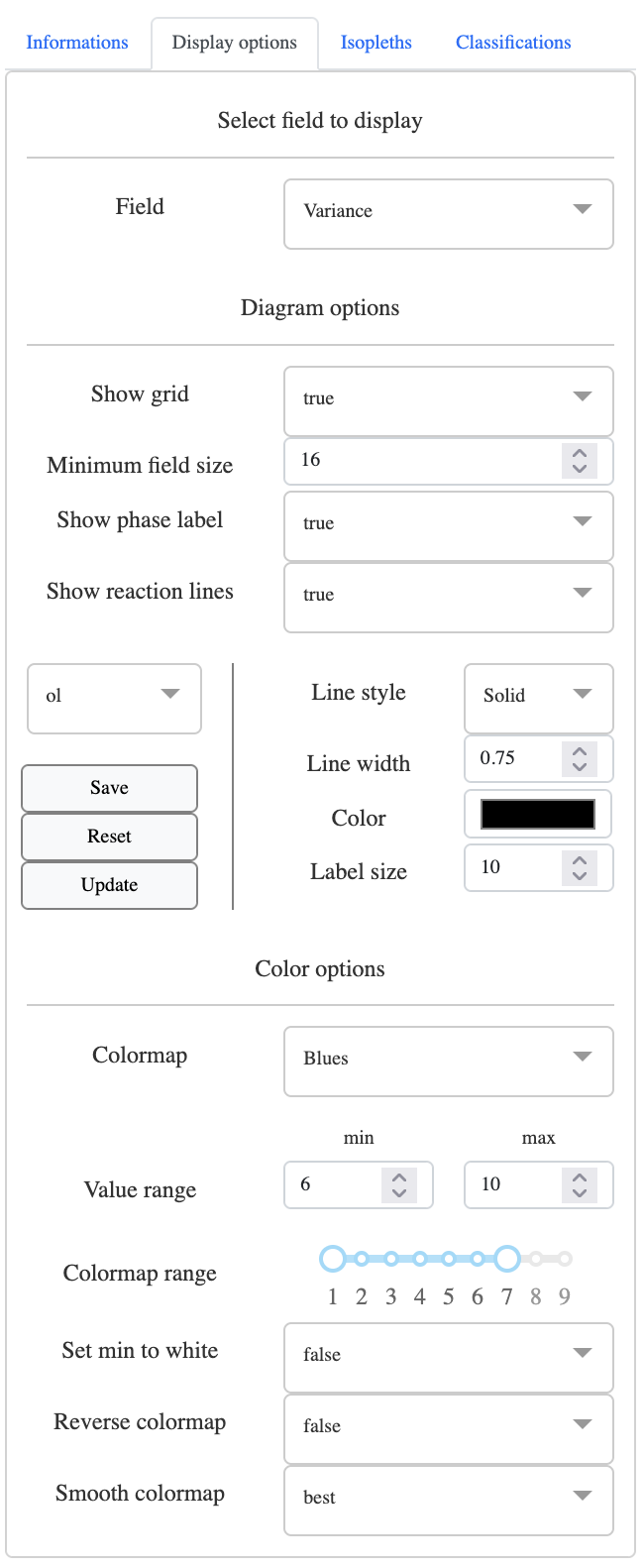 |
|
Note
Per-phase stable-color customization ("Modify phase colors") is configured from the PTX path tab (§7) and applies app-wide, not from this panel.
3.3. Isopleths panel
| Isopleths | Caption |
|---|---|
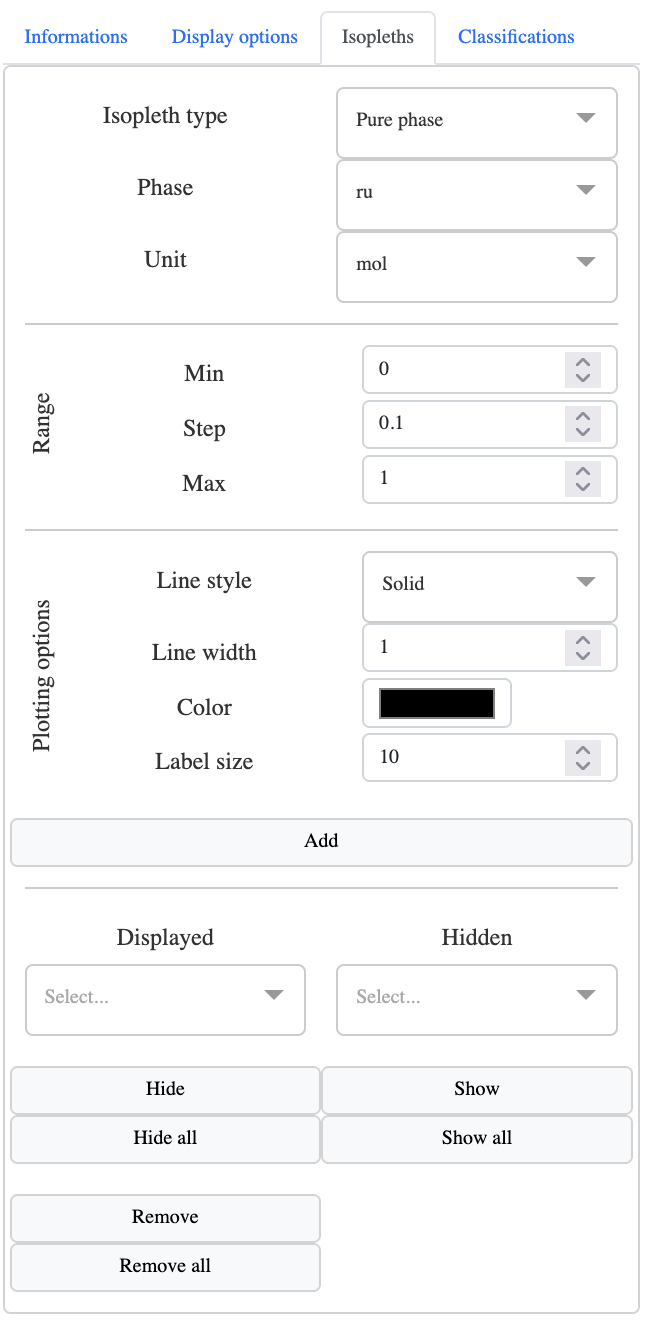 |
|
3.4. Draw path panel
This panel allows you to manually trace a P-T path directly on the phase diagram by clicking points, then extract the phase or field evolution along it.
| Draw path | Caption |
|---|---|
|
3.5. Uncertainty panel
Recomputes the current P-T phase diagram for many bulk-rock compositions to show how far each phase boundary moves. Two modes are available: Monte Carlo (random sampling), which perturbs the bulk with a 1σ per oxide (Bulk uncertainty table), and Linear between two bulks, which steps along the straight line from the reference bulk to a second bulk (Bulk variation card). The Run card sets the number of realizations (or steps) and launches the run; Display results reopens the result panel (boundary diagram, probability map, bulk spider diagram, SVG export). The status message at the top is shown until a P-T diagram with a fixed bulk composition has been computed. See 17. Bulk-rock uncertainty for a complete walkthrough.
3.6. Classifications panel
Note
Marked "Work in progress" in the app.
Computes and displays TAS and AFM classification diagrams for the melt composition across the computed grid.
| Classifications | Caption |
|---|---|
|
4. 3D diagram sub-tab
This sub-tab is only shown when Diagram type = P-T-X 3D diagram is selected in the Setup panel. Clicking Compute phase diagram then computes a regular three-dimensional grid and switches to this sub-tab when the calculation is complete:
P and T span the pressure and temperature ranges of the Setup panel;
X is the linear mixing between the two bulk-rock compositions of the Bulk-rock composition panel, labelled
X = 0(left) andX = 1(right) when this diagram type is selected, as for P-X and T-X diagrams. A message below the tables states what X represents, and warns when both compositions are identical (nothing would vary along X). When only one oxide differs between the two compositions (the others keeping their proportions), e.g. the H₂O content, the X axis of the figure is labelled with that oxide and its content in mol% (a P-T-H₂O diagram);the number of points along each axis is set by
3D grid [points per axis](no adaptive refinement). The progress bar reports the calculation one X plane at a time.
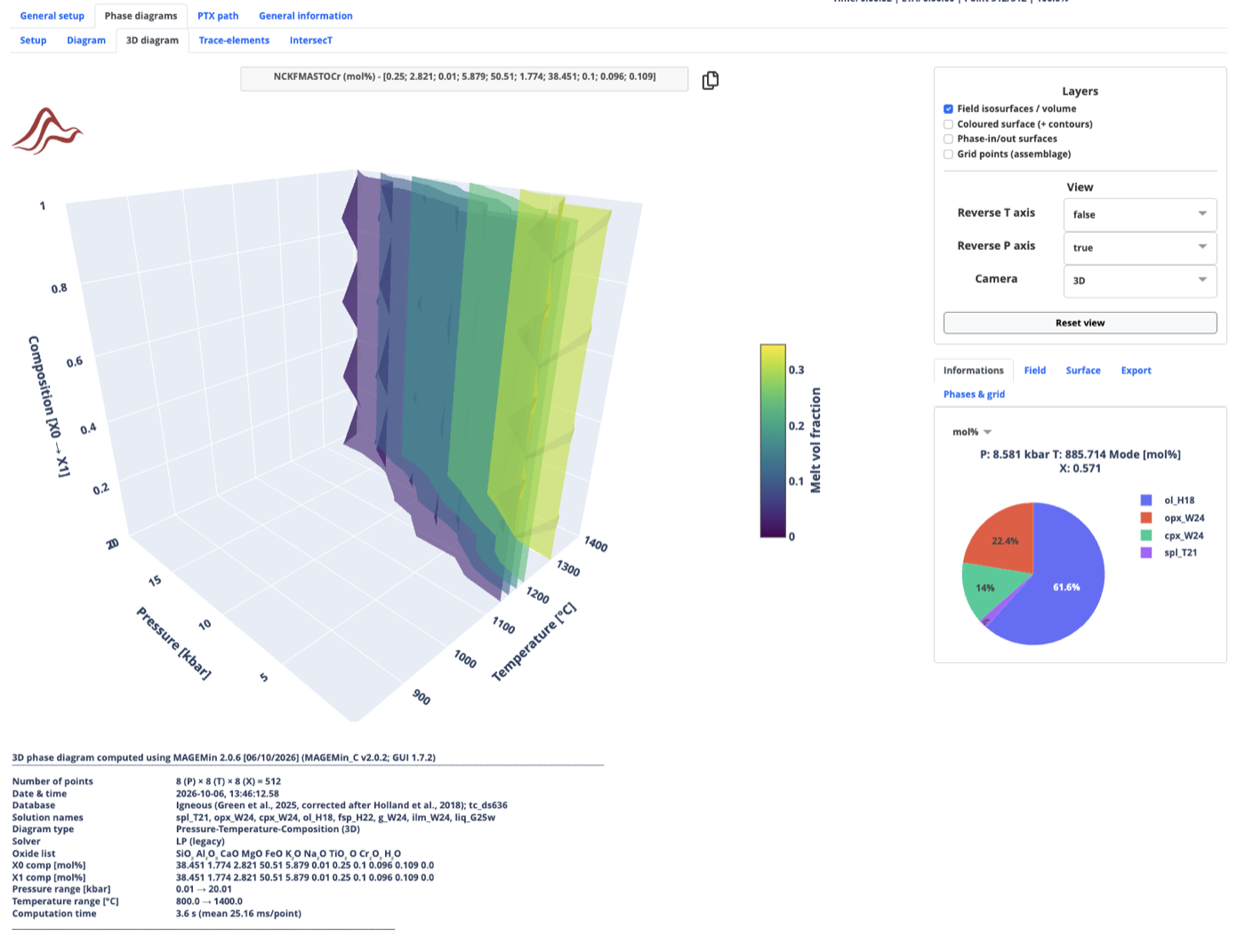
The sub-tab has the figure on the left and, on the right, an always-visible Display panel followed by five tabs: Informations, Field, Surface, Export and Phases & grid.
Tip
The quantity selectors of the Field and Surface panels follow the same structure as the Isopleths panel of the Diagram sub-tab:
Type(Pure phase, Solution phase or Other),Phase,Field(Mode, Oxide composition, Endmember mode, Mg#, Calculator oxides, Calculator apfu, Calculator site fractions; or a system field forOther), and only the options required by the selected field (Unit,Remove excess fluid,Oxide,Endmember, or the calculator expression, with the available site fractions listed for the site-fraction calculator).Phase compositions (Mg#, oxides, end-members, calculators) are undefined where the phase is not stable, so the corresponding surfaces stop at the phase stability boundary. Phase modes are zero where the phase is absent.
The computational cost grows with the number of grid points (roughly 4 ms per point on 12 threads, and ~30 kB of memory per point): 17 × 17 × 9 points take ~10-20 s, 33 × 33 × 33 points a few minutes and ~1 GB of memory.
4.1. Figure and composition bar
| Figure | Caption |
|---|---|
|
4.2. Display panel
| Display | Caption |
|---|---|
|
4.3. Informations panel
| Informations | Caption |
|---|---|
|
4.4. Field panel
| Field | Caption |
|---|---|
|
Note
A message is shown above the figure instead of the field when the selected quantity is undefined everywhere (e.g. invalid calculator expression) or constant over the whole diagram (e.g. a pure phase that is never stable).
4.5. Surface panel
The coloured surface reproduces a classic 3D representation: the surface on which a first quantity takes a given value, coloured by a second quantity, with labelled contour lines of a third quantity drawn on it (e.g. the surface of melt Mg# = 0.7, coloured by the melt fraction, with garnet modal contours). Colours and contour values are interpolated on the surface from the surrounding grid nodes where the quantity is defined, so that a surface lying on a phase boundary (e.g. garnet-in) can be coloured by a composition of that phase.
| Surface | Caption |
|---|---|
|
4.6. Export panel
| Export | Caption |
|---|---|
|
Note
Mesh and VTK coordinates are normalized to a 0-100 cube in data orientation (x = P, y = T, z = X, all increasing; the axis reversals of the view are not applied), so that the physical units do not distort the shapes and the meshes overlay the VTK grid exactly. The README of the mesh folder and the VTK header give the corresponding P, T and X ranges.
4.7. Phases and grid panel
| Phases & grid | Caption |
|---|---|
|
5. IntersecT sub-tab
Implements quantitative isopleth thermobarometry (Nerone et al., 2025, doi:10.1016/j.cageo.2025.105949): for every grid point of a previously computed phase diagram, the modelled a.p.f.u. composition of one or several mineral phases is compared to a measured (e.g. EPMA) composition, returning a goodness-of-fit map.
Warning
Requires Mineral names = Warr (2021) in 1.1 General parameters panel - IntersecT matches phases between the measurement file and the computed grid using Warr (2021) symbols.
The sub-tab is organized in three columns: Setup, Results (Diagrams / Log), and Options.
5.1. Setup panel
| Setup | Caption |
|---|---|
|
5.2. Results panel
| Results | Caption |
|---|---|
|
5.3. Options panel
| Options | Caption |
|---|---|
|
6. Trace-elements sub-tab
The Trace-elements sub-tab becomes active after a phase diagram has been computed with TE predictive model = true. It displays element distributions and saturation fields across the phase diagram.
6.1. REE spectrum panel
Open by default, above the main diagram.
| Rare Earth Elements spectrum | Caption |
|---|---|
|
6.2. General options panel
| General options | Caption |
|---|---|
|
6.3. Display options
| TE Display options | Caption |
|---|---|
|
6.4. TE Isopleths
The Isopleths panel in the Trace-elements sub-tab works identically to the one in the Diagram sub-tab but operates on TE and saturation fields (Zircon, Sulfide, Fluorapatite, CO₂ saturation, Trace element) instead of thermodynamic fields; for the Trace element type it exposes a Calculator expression plus a normalization setting (bulk, chondrite, none) and a custom field name.
6.5. Export figure and Phase assemblages panels
| Side panels | Caption |
|---|---|
|
7. PTX path tab
The PTX path tab is divided into a left configuration panel and a central results area. It supports all P-T-X path modes from the same interface, including isentropic paths, which combine with every other mode (fractional melting/crystallization, assimilation, trace elements).
7.1. Configuration panel
| Configuration | Caption |
|---|---|
|
7.2. Bulk-rock composition panel
Same controls as the phase diagram bulk-rock panel (§2.2). When Assimilation = true, a second bulk-rock composition panel appears for the assimilated end-member.
7.3. Trace Elements panel
Appears when TE predictive model = true in Path options.
| Trace Elements (PTX) | Caption |
|---|---|
|
7.4. Path definition panel
| Path definition | Caption |
|---|---|
|
7.5. Path options panel
| Path options | Caption |
|---|---|
|
7.6. PTX save and export
All export options are located in the Path options panel:
| Button | Content |
|---|---|
Save path → csv | Full path: P, T, phase fractions and compositions at each step |
Save path → csv line | Same but all steps on a single row |
Save cumulate → csv file | Composition of the cumulate (extracted solid) at each step |
Save trace elements → csv file | TE concentrations in melt, solid and minerals at each step (requires TE computation) |
Save cumulate TE → csv file | Integrated cumulate TE composition at each step (requires TE computation) |
Export references → bibtex file | BibTeX citations for active models and database |
Note
The
Save trace elementsandSave cumulate TEbuttons are only active after trace elements have been computed.The export path is printed in the Julia terminal.
8. General information tab
Provides static reference data across three sections:
Solution phases table - full mineral name, abbreviation, Warr (2021) symbol and solvus daughters, for every solution phase of every database (short and citation-tagged names alike), sorted alphabetically;
-marks a phase with no Warr equivalent or no solvus (filterable, 16 rows per page)End-members table - full mineral name, abbreviation, Warr (2021) symbol and composition in the 15-oxide basis of the global database, sorted alphabetically (filterable, 16 rows per page)
CSV bulk-rock format - example table showing the required column structure for bulk-rock input files (title, comments, db, sysUnit, oxide columns, optional _frac2 variants), followed by the full field documentation including the thermodynamic dataset acronym table (mtl, mp, mb, ig, igd, igad, um, sb11, sb21, sb24, ume, mpe, mbe, all)
Trace-element Kd tables - three tabs subdivided by SiO₂ content of the melt (
SiO2 < 52 wt%,52 wt% <= SiO2 < 63 wt%,63 wt% <= SiO2); each shows the element × mineral Kd matrix (filterable, 32 rows per page)Calculation details - static reference cards describing phase deactivation logic, oxide activity formulation, water saturation methodology, specific heat capacity calculation, the site fraction calculator, and seismic velocity corrections (melt/anelastic/shallow, cross-referencing the PTX path Configuration panel controls)
Note
Trace-element partitioning model descriptions and Kd tables are documented in the Thermodynamic Databases page.